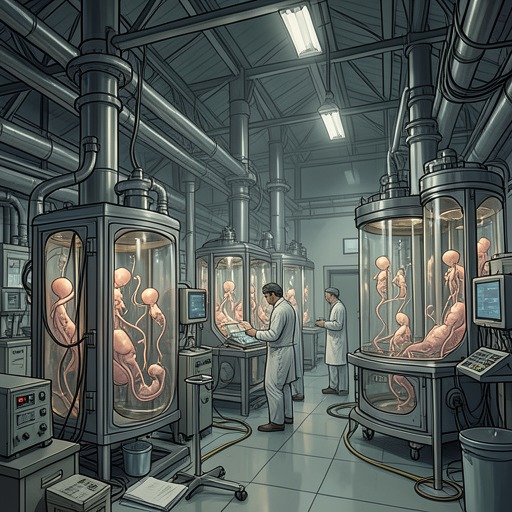
Class-consciousness lessons implanted in children's sleep
Brave New WorldClass-consciousness lessons implanted in children's sleep turn the World State’s caste hierarchy into a voice repeated beneath sleeping children’s pillows. In the lesson presented at the Central London Hatchery and Conditioning Centre, a child learns not merely which caste performs which work, but to feel satisfied with its own assigned place and to look down on those below it. The episode makes education a technology of social reproduction: State-authored suggestions are repeated until they seem to constitute the mind that will later judge, desire, and decide.
The Lesson and Its Audience
The Director visits the sleeping room during an afternoon lesson. A nurse explains that the children have spent the first forty minutes on Elementary Sex and are now listening to Elementary Class Consciousness. The Director asks for the new lesson to be repeated more loudly through the trumpet, and a wall loudspeaker projects the recording over a room containing eighty sleeping boys and girls. The lesson is therefore presented not as a conversation or a reasoned class, but as a broadcast addressed to children who remain asleep.
The recording begins in mid-sentence and speaks in the voice of a child. It sorts people by the colours of their clothes: Alphas wear grey, Gammas and Deltas wear green, Delta children wear khaki, and Epsilons wear black. Its speaker identifies as a Beta and declares gladness at belonging to that caste. The lesson thus makes social rank legible through simple, memorable contrasts: clothing, intelligence, work, and the preference to play with some children rather than others.
Repetition Makes Rank Feel Natural
The recording does not present the hierarchy as an argument to be examined. It rehearses a child’s aversion to Delta children and describes Epsilons as too stupid to read or write; it also teaches the Beta speaker to regard Alphas as cleverer and more hardworking, while taking pride in doing less work than they do. The hierarchy is absorbed through comparisons that make each rank seem to have its own obvious traits and proper attitude toward the others.
The Director explains the schedule behind the recording. The children will hear the lesson forty or fifty more times before waking, then again on Thursday and Saturday: 120 repetitions, three times a week, for thirty months. They will then move on to a more advanced lesson. The precise timetable gives the process its force. A belief is not planted once and left to chance; it is returned to the child’s sleeping mind over months, at a frequency designed to make the recorded judgments familiar before the children can consciously assess them.
From Childhood Suggestion to Adult Judgment
The Director describes the intended result as more than a memorized classroom formula. In his account, the child’s mind becomes the suggestions, and the adult mind remains made of them throughout life. Because the State supplies those suggestions, the lesson links private judgment to public authority: what adults experience as their own judgments and desires has been formed by a message devised to preserve the established order.
That claim also clarifies why the recording uses words but not reasoning. Earlier conditioning can bind a flower or a shock to an immediate response, but the finer distinctions and complex behavior required by the social order need language. Sleep teaching supplies that language without asking the child to weigh the evidence. Its apparent simplicity—who wears which colour, who is clever, who is desirable as a playmate—conceals a lasting political purpose: to make the caste system feel like common sense rather than a system imposed and maintained by the State.
Class Instruction Within a Wider Social Order
The lesson’s emotional logic belongs to a society that treats stability as a condition of civilization. Elsewhere, the Controller presents stability as dependent on individual stability, and describes the population as people who must be kept steady and content so the social machinery continues to turn. The sleeping lesson performs this work early: instead of leaving caste difference to become a source of comparison or resentment, it trains children to interpret rank through ready-made judgments and satisfaction with their own position.
The same governing logic appears in the society’s management of feeling and leisure. The Controller says that lives have been made emotionally easy, in part by removing the interval between desire and its satisfaction. At Westminster, Lenina and Henry take soma with their meal before going to a cabaret, where entertainment and repeated slogans occupy the evening. Much later, Mustapha Mond argues that shorter hours and labour-saving inventions are withheld because additional leisure could bring unrest rather than happiness. Together, these details frame class-consciousness teaching as one part of a larger system: work, pleasure, and belief are organized to support stability, and the lesson prepares children to inhabit their assigned roles without needing to question the arrangement.